
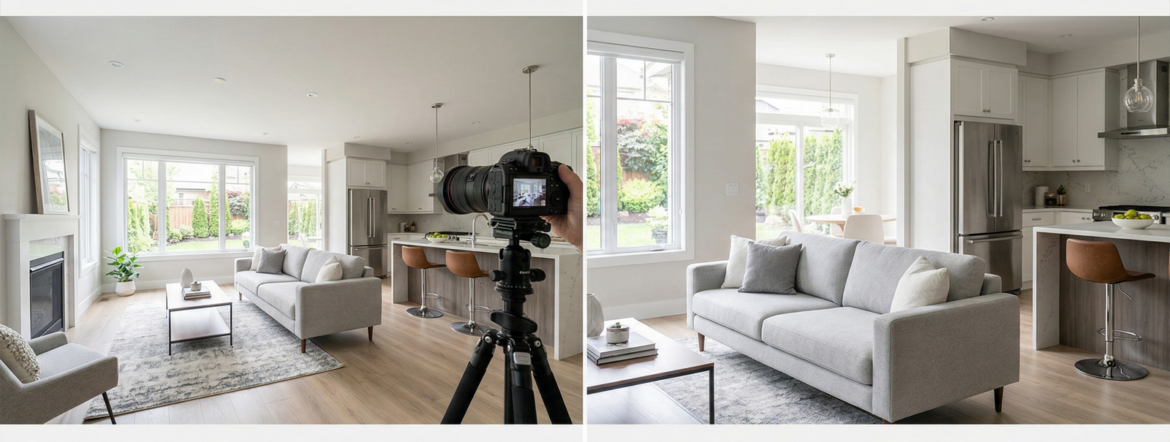
In the world of real estate, space is everything. As a photographer, your job is to make a 10×10 bedroom look like a sanctuary and a sprawling open-concept living area feel as grand as it does in person. But when you’re standing in the corner of a cramped powder room, the gear in your bag suddenly matters a lot.
The question of Full Frame vs. Crop Sensor (APS-C) is one of the most debated topics for architectural shooters. While both can get the job done, they offer very different advantages. Let’s break down which one belongs in your camera bag.
Understanding the “Crop Factor”
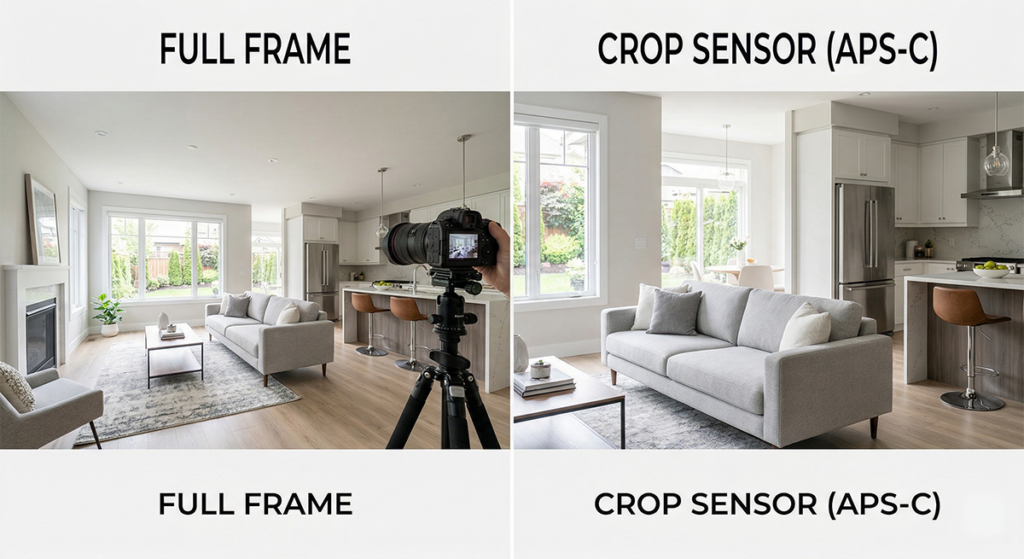
Before we dive into the pros and cons, let’s talk about why “crop” is even a thing. A Full Frame sensor is the same size as traditional 35mm film ($36\text{mm} \times 24\text{mm}$). A Crop Sensor (usually APS-C) is smaller.
Because the sensor is smaller, it literally “crops” the image. On a standard Sony or Nikon crop camera, you have a 1.5x crop factor. This means a 16mm wide-angle lens—the bread and butter of real estate—suddenly behaves like a 24mm lens. In a tight kitchen, that difference is the difference between showing the whole island or just a corner of the sink.
Full Frame: The Professional Standard
For most high-end real estate photographers, full frame is the gold standard. Here’s why:
The Pros
- True Wide Angles: You get the full field of view from your lenses. A 14mm lens stays a 14mm lens, allowing you to capture entire rooms in a single frame without “fisheye” distortion.
- Superior Dynamic Range: Real estate is all about “window pulls”—balancing a dark interior with a bright sunny view outside. Full-frame sensors capture more data in the highlights and shadows, making post-processing a breeze.
- Low Light King: Shooting a dimly lit basement or a “twilight” exterior? Full-frame sensors have larger pixels that soak up more light, resulting in much cleaner images with less digital noise.
The Cons
- Price Tag: Both the bodies and the high-quality wide-angle glass (like a 16-35mm f/2.8) are significantly more expensive.
- Size and Weight: Full-frame setups are generally bulkier, which can be a literal pain if you’re shooting 5–10 properties a day.
Crop Sensor: The Efficient Underdog
Don’t count out the APS-C sensor just yet. For many entry-level and high-volume photographers, it’s a powerhouse.
The Pros
- Budget-Friendly: You can often get a professional-level crop body and a dedicated wide-angle lens for half the price of a full-frame equivalent.
- Lighter Workflow: Smaller cameras mean smaller gimbals and smaller tripods. If you’re moving fast, this is a huge win.
- Greater Depth of Field: This is a “secret” pro for real estate. Because of the smaller sensor, it’s actually easier to get the entire room in sharp focus from the foreground to the back wall.
The Cons
- The Struggle for Width: Finding an ultra-wide lens that remains wide after the 1.5x crop is difficult and often leads to more barrel distortion.
- More Noise: In low-light situations, you’ll notice grain in the shadows much sooner than you would with full frame.
Comparison at a Glance
| Feature | Full Frame | Crop Sensor (APS-C) |
| Field of View | True to lens (Ultra-wide) | Narrower (1.5x – 1.6x crop) |
| Dynamic Range | Excellent (Best for HDR) | Good (May struggle with windows) |
| Low Light | Very Clean | Noticeable Grain/Noise |
| Cost | $$ | |
| Best For | Luxury, Commercial, Twilight | Standard Listings, High Volume |
The Verdict: Which Should You Choose?
If you are shooting luxury listings, architectural portfolios, or high-end commercial spaces, Full Frame is non-negotiable. The image quality and wide-angle capabilities are essential for the “wow” factor those clients demand.
However, if you are just starting out or focusing on standard residential listings where speed and cost-effectiveness are key, a Crop Sensor camera paired with a dedicated wide-angle lens (like a 10-18mm or 10-20mm) will serve you perfectly well.